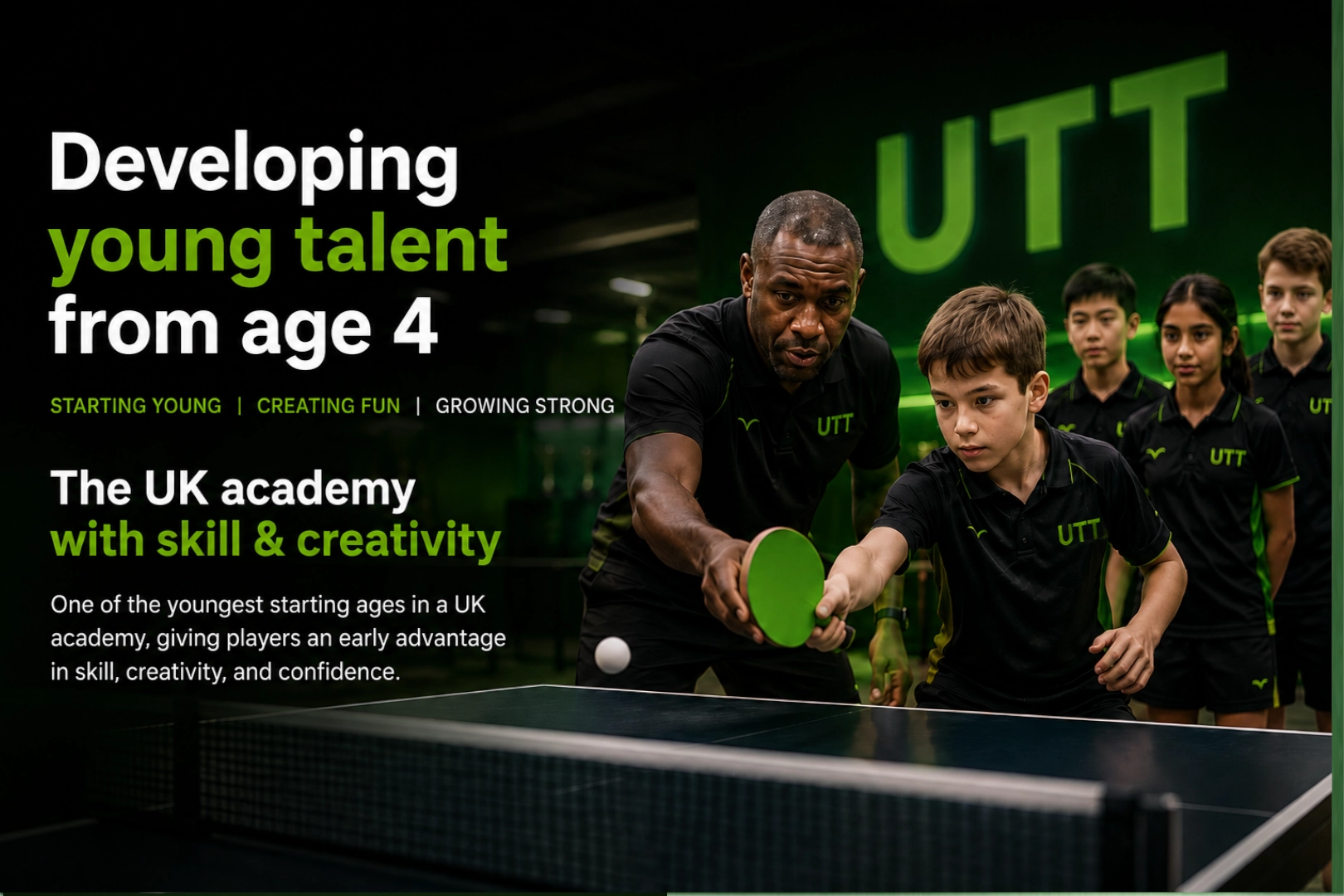
To establish Universal Table Tennis (UTT) as a global network of high-quality development hubs, beginning with GMTTA as the flagship UK hub. Our vision includes creating a world-class facility with 100 tables, inspiring confident, creative players from age 4 through to elite level, and ultimately expanding to multiple venues nationally and internationally while nurturing participation and world-class talent.
To develop confident, creative table tennis players from as young as 4 through to elite level at GMTTA using The Best of Both Worlds approach. Our mission is to provide innovative coaching, foster adaptability and independence, promote longevity in the game, and inspire participation while nurturing world-class talent.
The Journey Behind the Academy
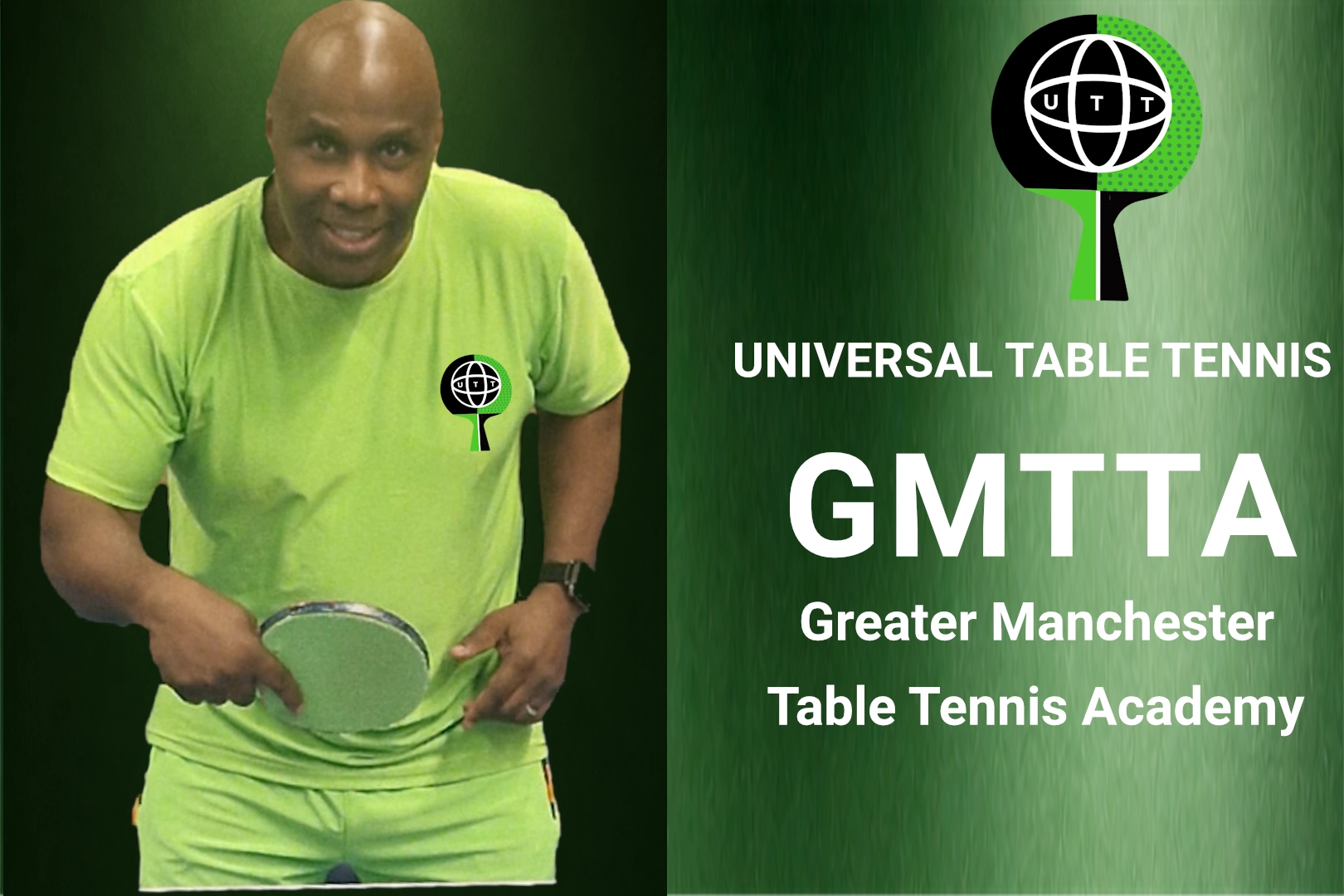
Greater Manchester Table Tennis Academy (GMTTA), the operational hub of Universal Table Tennis (UTT), was founded by Dave Griffith in April 2024 with a clear purpose: to develop players differently, building a pathway from beginner to elite level. Through years of playing and coaching experience, it became clear that many players were being trained in similar ways, often leading to predictable styles and limited adaptability in competition. GMTTA was created to challenge that pattern, providing a more complete and flexible approach to player development.
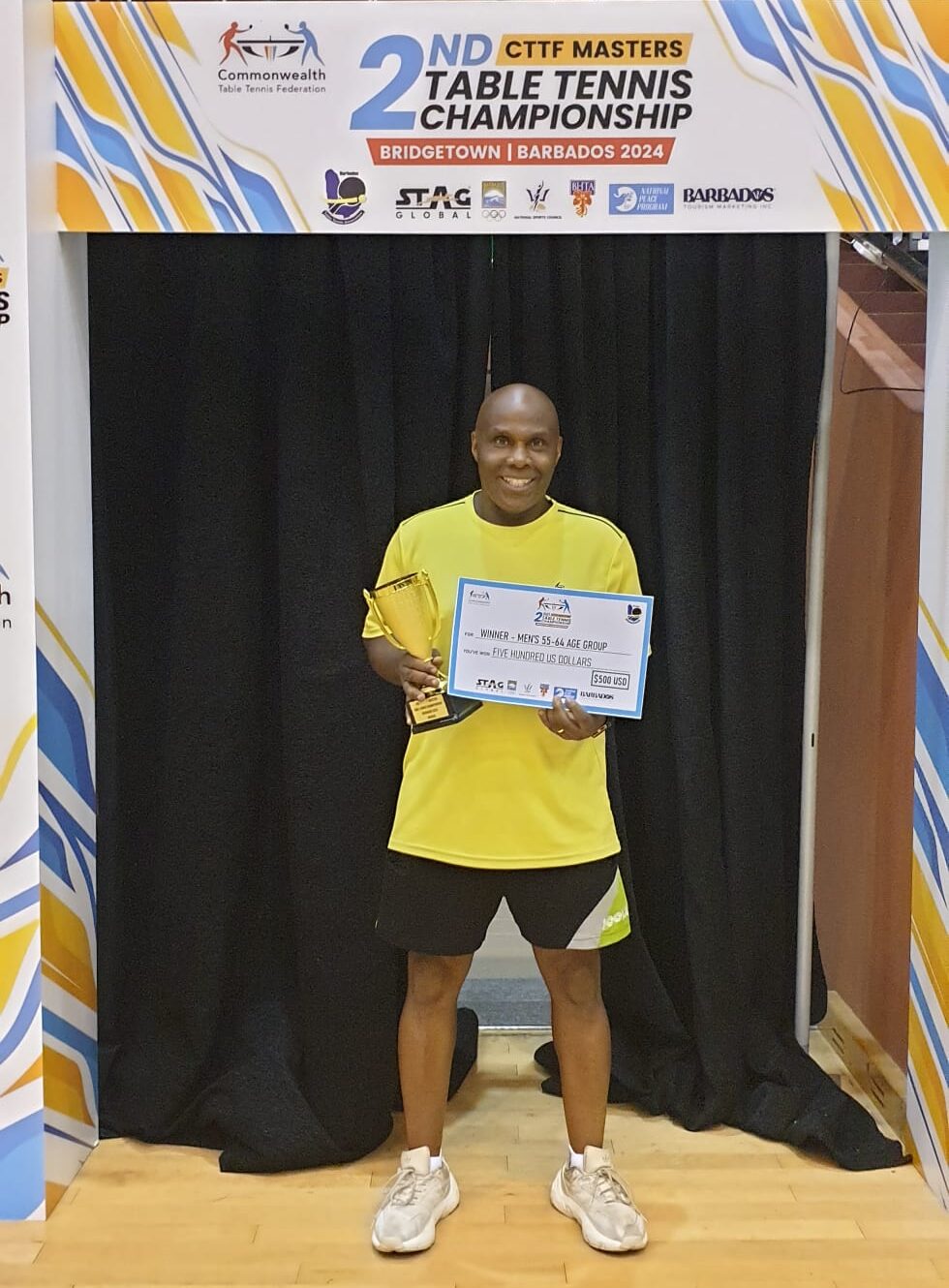
I have spent my life playing, coaching, and officiating table tennis at the highest levels. Proving that it is never too late to reach the world stage, I am making my elite international debut at age 62 to represent Barbados in the Commonwealth Championships this year. My goal is to help players grow into confident, adaptable champions while making sure the sport treats everyone fairly, regardless of their age, race, gender, or financial background. This unique approach to the game is exactly how I coached my own daughters to national dominance and Olympic selection, and it forms the very foundation of our academy today.
GMTTA’s coaching philosophy, known as The Best of Both Worlds, combines conventional and unconventional playing styles, (the use of ‘Funny Rubbers’ such as long pimples and anti-spin).Why this works is simple: it breaks the rhythm of the modern game. While most clubs train players to hit the exact same fast, predictable spin over and over, we teach players how to change the ball’s physics mid-rally. By blending control, twiddling (rotating the bat), disruption, and confusion, our players can instantly change a heavy spin into no spin, or return a smash with an unexpected backspin block. This forces the opponent to make mistakes, slows down their reactions, and makes our players completely unpredictable in competition.The living proof of this philosophy is my own current journey: at age 62, I am making my international debut at the Commonwealth Championships using a long pimples and smooth rubber layout (combination bat). At this stage of life, trying to match younger athletes with raw power and explosive speed around the table is impossible. Instead, my unique style allows me to neutralise their power, giving me a real chance to dictate the game on my own terms. Competing at this elite international level would simply not be possible using standard smooth rubbers.Our approach promotes highly efficient, controlled play. Instead of relying purely on raw physical speed and exhausting muscle power, our players use strategy, placement, and variation. This drastically reduces physical strain on the body, allowing athletes to sustain peak performance and stay competitive at a high level for decades.Table tennis once thrived in community spaces such as YMCA centres, workplaces, and local clubs across Greater Manchester, famously producing legendary world-class masters. This environment raised icons like John Hilton—who famously won the 1980 European Championship utilising the exact style of tactical rubber variation that inspires our philosophy today—alongside the legendary Desmond Douglas, the fast attacking pioneer affectionately known as “The Human Brick Wall.” The aim of our academy is to help restore that level of visibility and participation within the sport across the region, while developing more players capable of reaching that standard and beyond.The long-term dream is to establish a world-class facility with at least 100 table tennis tables to host local, national and international events, while ultimately expanding to multiple venues across Greater Manchester and beyond. Achieving this will require support, collaboration, and shared belief in the potential of the sport. Ambitions like this drive progress and build a lasting legacy for players and communities alike.
The Journey Behind the Academy
Greater Manchester Table Tennis Academy (GMTTA), the operational hub of Universal Table Tennis (UTT), was founded by Dave Griffith in April 2024 with a clear purpose: to develop players differently, building a pathway from beginner to elite level. Through years of playing and coaching experience, it became clear that many players were being trained in similar ways, often leading to predictable styles and limited adaptability in competition. GMTTA was created to challenge that pattern, providing a more complete and flexible approach to player development.
I have spent my life playing, coaching, and officiating table tennis at the highest levels. Proving that it is never too late to reach the world stage, I am making my elite international debut at age 62 to represent Barbados in the Commonwealth Championships this year. My goal is to help players grow into confident, adaptable champions while making sure the sport treats everyone fairly, regardless of their age, race, gender, or financial background. This unique approach to the game is exactly how I coached my own daughters to national dominance and Olympic selection, and it forms the very foundation of our academy today.
GMTTA’s coaching philosophy, known as The Best of Both Worlds, combines conventional and unconventional playing styles, (the use of ‘Funny Rubbers’ such as long pimples and anti-spin).Why this works is simple: it breaks the rhythm of the modern game. While most clubs train players to hit the exact same fast, predictable spin over and over, we teach players how to change the ball’s physics mid-rally. By blending control, twiddling (rotating the bat), disruption, and confusion, our players can instantly change a heavy spin into no spin, or return a smash with an unexpected backspin block. This forces the opponent to make mistakes, slows down their reactions, and makes our players completely unpredictable in competition.The living proof of this philosophy is my own current journey: at age 62, I am making my international debut at the Commonwealth Championships using a long pimples and smooth rubber layout (combination bat). At this stage of life, trying to match younger athletes with raw power and explosive speed around the table is impossible. Instead, my unique style allows me to neutralise their power, giving me a real chance to dictate the game on my own terms. Competing at this elite international level would simply not be possible using standard smooth rubbers.Our approach promotes highly efficient, controlled play. Instead of relying purely on raw physical speed and exhausting muscle power, our players use strategy, placement, and variation. This drastically reduces physical strain on the body, allowing athletes to sustain peak performance and stay competitive at a high level for decades.Table tennis once thrived in community spaces such as YMCA centres, workplaces, and local clubs across Greater Manchester, famously producing legendary world-class masters. This environment raised icons like John Hilton—who famously won the 1980 European Championship utilising the exact style of tactical rubber variation that inspires our philosophy today—alongside the legendary Desmond Douglas, the fast attacking pioneer affectionately known as “The Human Brick Wall.” The aim of our academy is to help restore that level of visibility and participation within the sport across the region, while developing more players capable of reaching that standard and beyond.The long-term dream is to establish a world-class facility with at least 100 table tennis tables to host local, national and international events, while ultimately expanding to multiple venues across Greater Manchester and beyond. Achieving this will require support, collaboration, and shared belief in the potential of the sport. Ambitions like this drive progress and build a lasting legacy for players and communities alike.
Our approach is influenced by proven players, developed through experience, and passed on to the next generation from age 4. From John Hilton’s innovation to Rebekah Higgs’ success, this pathway continues through GMTTA.

John Hilton is one of England’s most iconic table tennis players, best known for his historic victory at the 1980 European Table Tennis Championships in Bern, where he became Men’s Singles Champion against the odds. His success remains one of the greatest achievements in English table tennis history.
He was renowned for his innovative and unconventional playing style, using a combination of smooth and anti-spin rubbers alongside twiddling techniques to disrupt opponents. At the time, both sides of the bat were the same colour, making it extremely difficult for opponents to read spin and variation. This style of play contributed to the introduction of the two-colour rubber rule, improving visibility and fairness in the sport, especially against deceptive twiddling.
In his later years, John evolved his game further, adopting short and long pimples while continuing to use twiddling to create even greater unpredictability, making him exceptionally difficult to play against.
Beyond his playing achievements, John has made a lasting impact as a coach, including coaching Dave Griffith, contributing to the development of his understanding of technique, tactics, and creative play. His influence reflects the core values of The Best of Both Worlds — combining strong fundamentals with innovation and adaptability.
John Hilton’s legacy continues to inspire players at all levels, and we are honoured to have his involvement with Greater Manchester Table Tennis Academy.
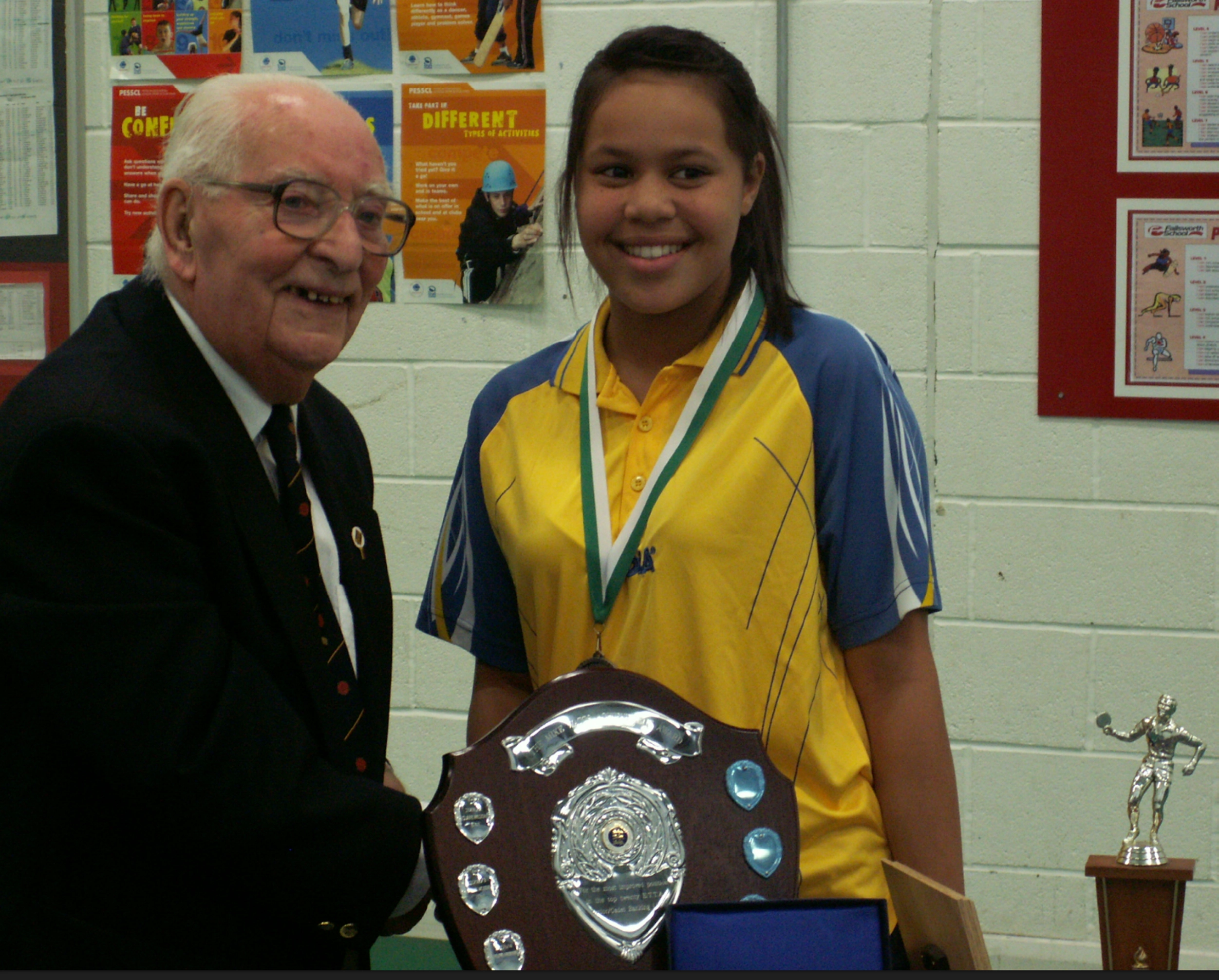
Together, John Hilton and Rebekah Higgs represent two generations of innovation, determination, and creativity in table tennis, demonstrating that unique playing styles can successfully challenge the conventional style and achieve success. Their involvement reflects our commitment to developing players through The Best of Both Worlds philosophy — blending strong fundamentals with creativity and individuality.
At GMTTA, we combine early development, creativity, and individuality to create players who thrive at every level.
We develop players from age 4, giving them the confidence, skill, and creativity to succeed.
Our coaching nurtures individuality, helping players think and play differently.
From beginners to aspiring elite players, we guide all players to reach their potential.
Whether you’re looking for holiday sessions, weekly coaching, or long-term player development, we have the right programme for your child.
Have questions? Our team is happy to help you find the perfect session.